

Ever since the xG revolution took place, everyone loves saying that xG killed long-range screamers. Well … that sounds like the perfect topic for this little newsletter.
Welcome to The Python Football Review #018.
In this issue, you’ll learn:
how much the average shot distance has dropped over the last 11 seasons
whether this shift actually affected conversion rates
and whether the “death of the screamer” is a myth or a real trend
As always, the full code is available at the end so you can reproduce the analysis from scratch, check the numbers, and mock my conclusions if you want.
Let’s get into it.
A few words on the data
For this study, we’ll use 11 seasons of data (2014/15 to 2024/25) from Europe’s top five leagues, courtesy of Understat (via soccerdata). The dataset includes roughly half a million shots. We focus solely on open-play shots.
The data is already clean. We just need to add three features:
shot distance in meters, calculated from the pitch coordinates of each shot
a dummy variable (1/0) for shots outside the box
a dummy variable for shots taken from 25+ meters (our definition of a long-range shot)
1 — How did shot volume evolve?
Across Europe’s top five leagues, the average number of open-play shots per match has been remarkably stable. In 2014/15 we recorded 16.6 shots per match, and in 2024/25… also 16.6.
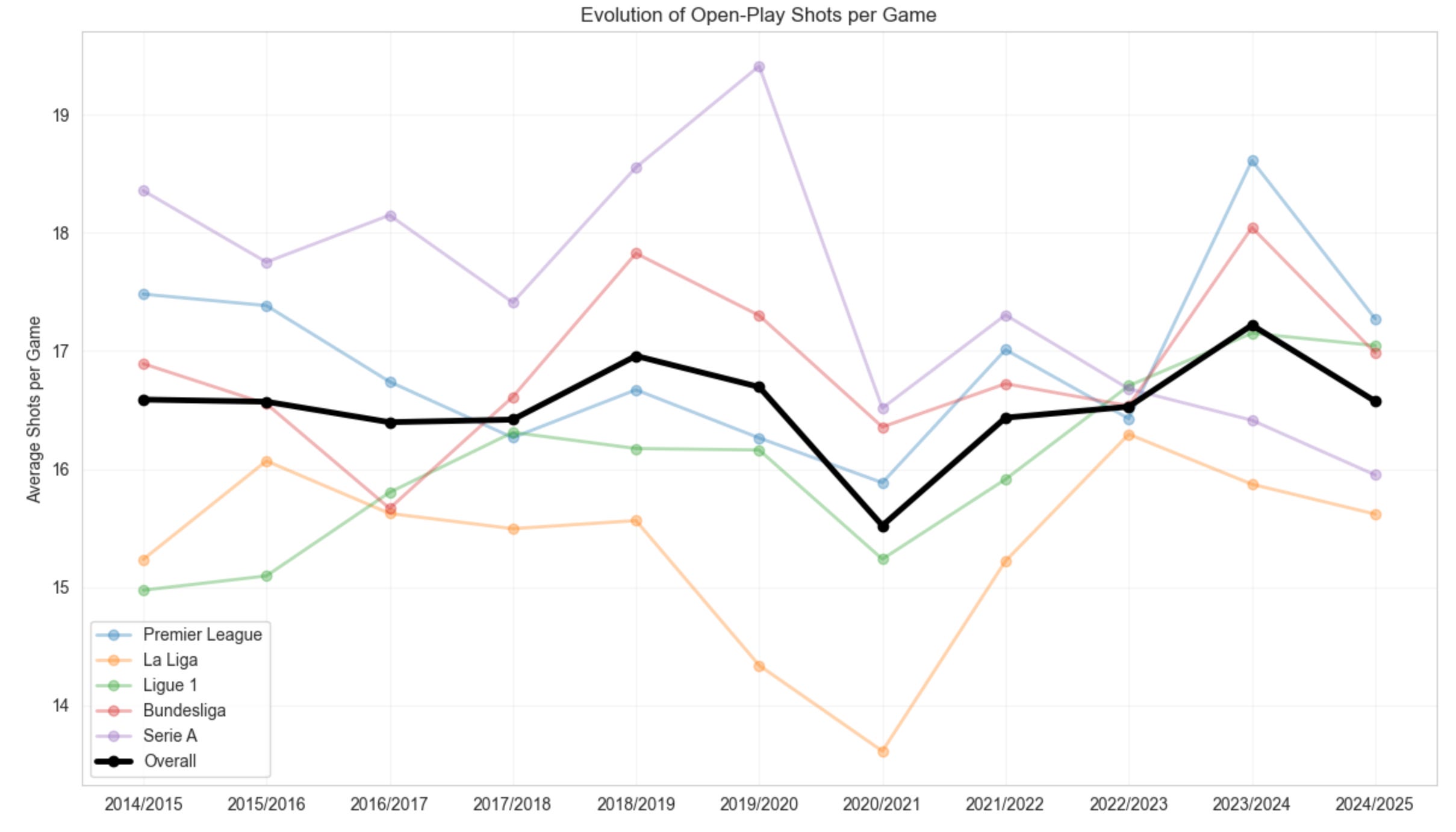
There’s some negligible year-to-year variance, but nothing that suggests a structural change. So no, teams are not shooting less overall.
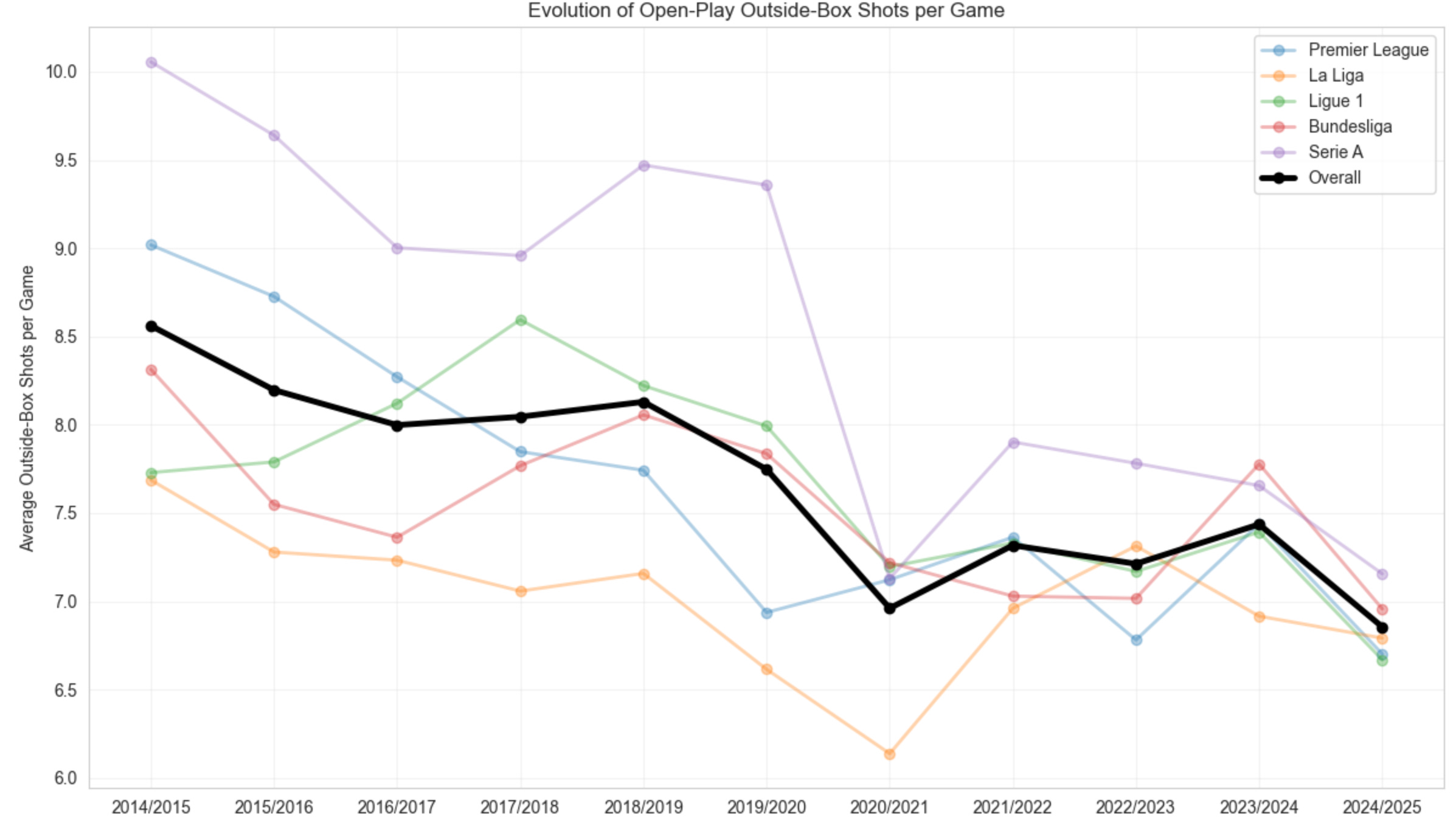
What about the shots from outside the box? Now it gets interesting. Outside-the-box shots fell from 8.6 to 6.9 per match — a 20% decline.
And what about the shots from 25 meters or more (i.e. the “screamer zone”) ? These shots dropped from 5.4 to 3.7 per match — a 31% drop.
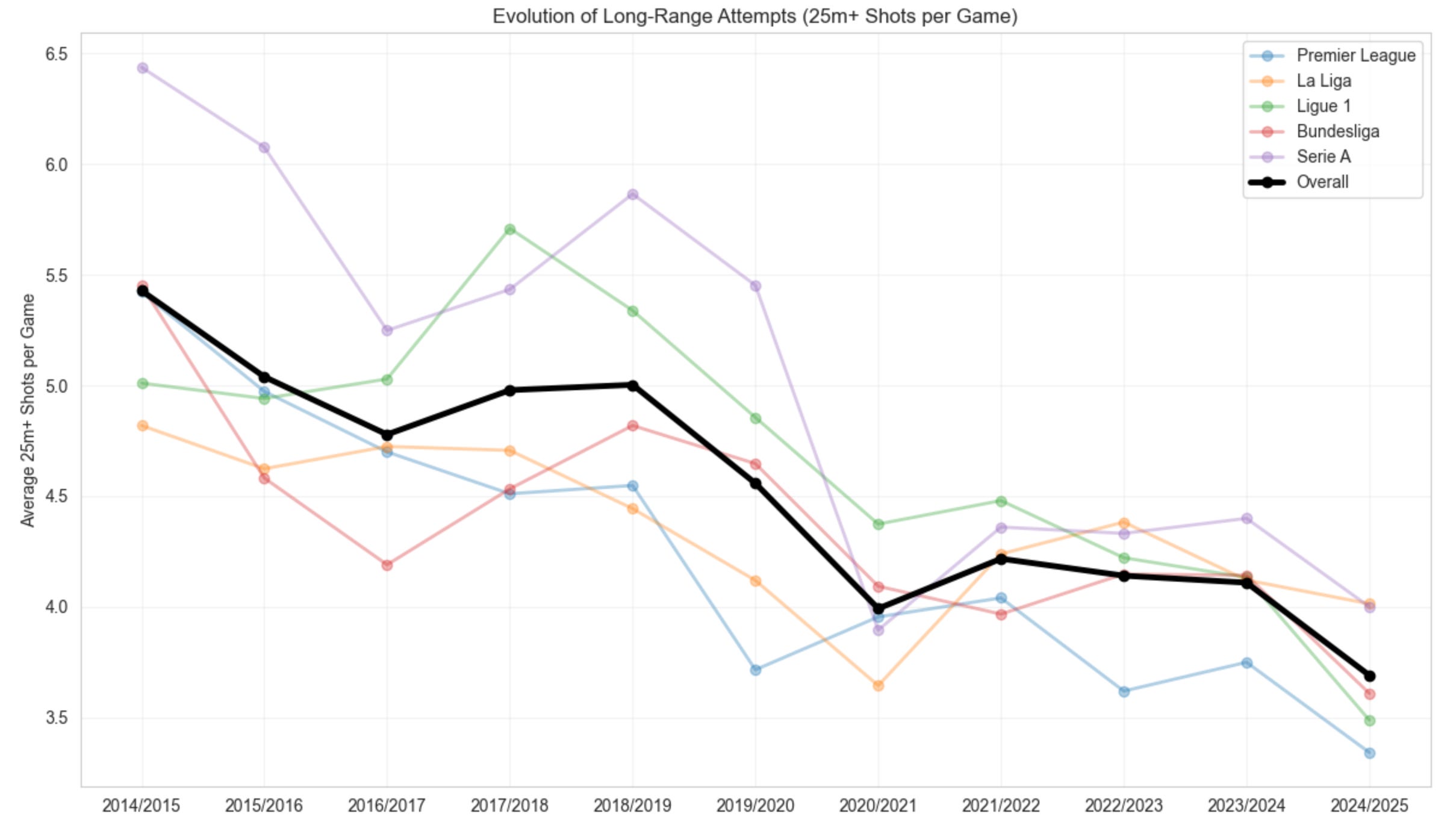
This is the trend people usually talk about when they say “xG killed long-range shots,” and to be fair, the decline is real and observable across all leagues.
2 — What about shot distance?
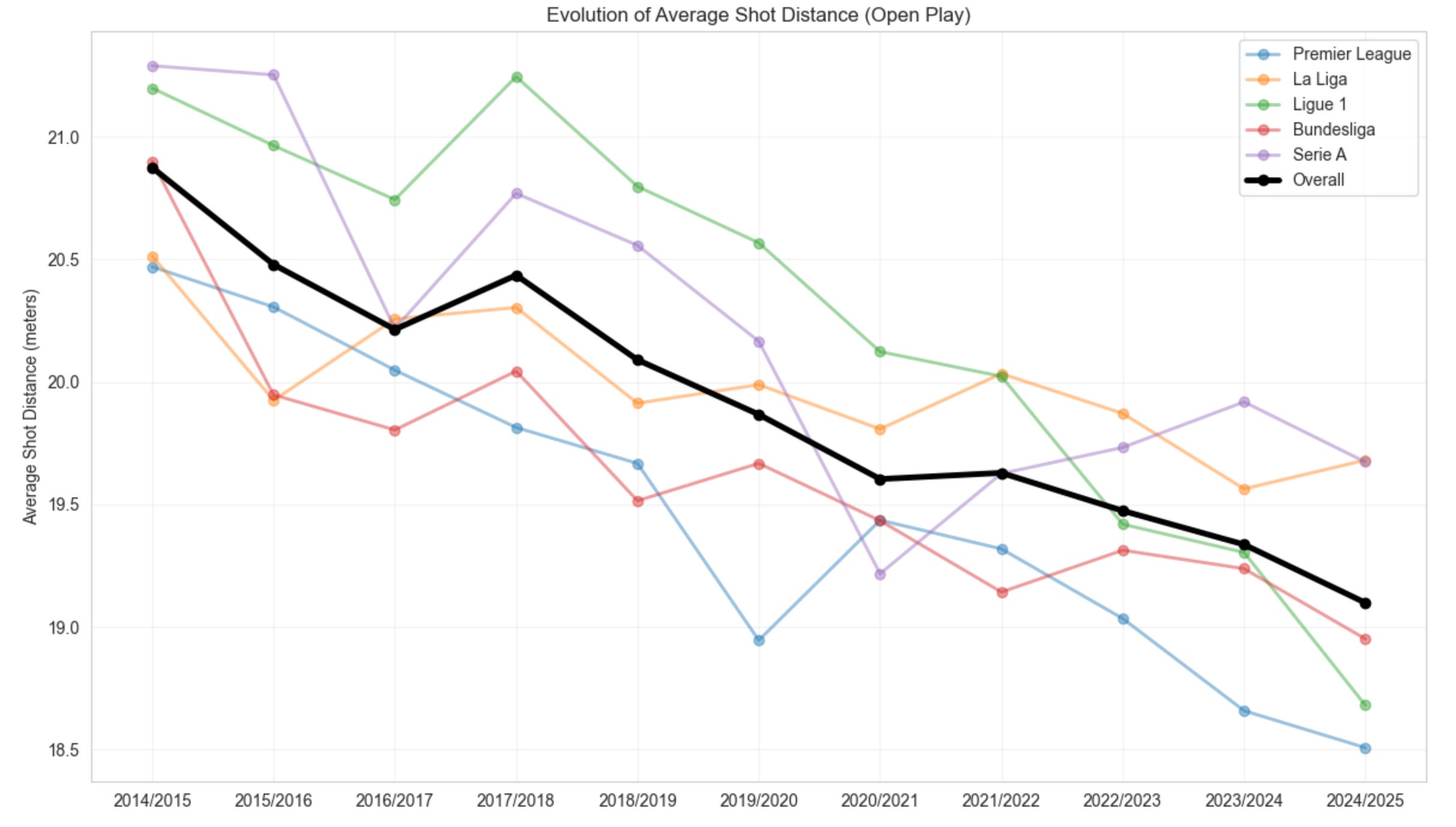
Across all open-play shots, the average shot distance dropped from 20.8m to 19.1m — an 8% decrease.
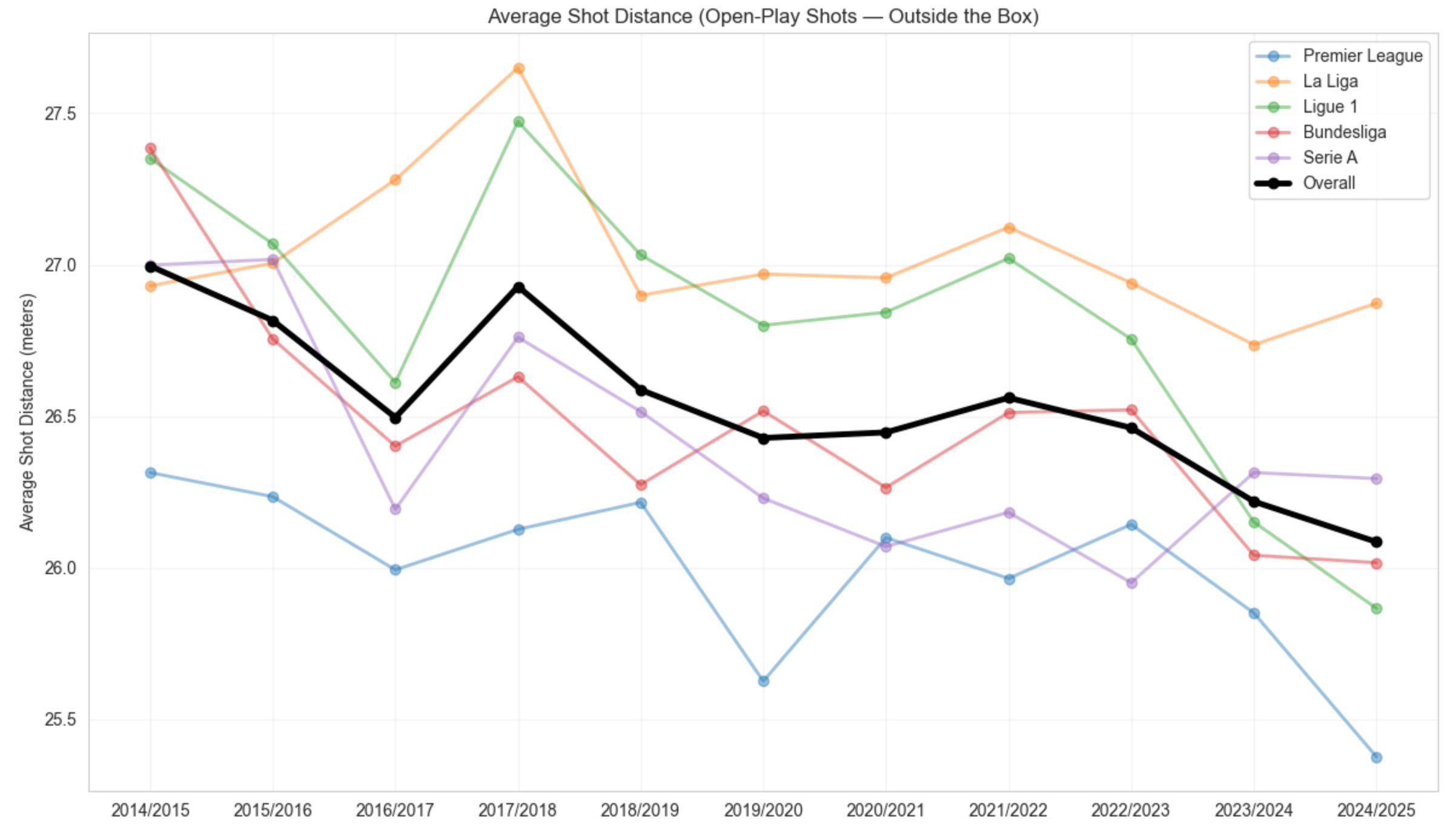
Outside-the-box shots distance dropped from 27m to around 26m — roughly 4% down.
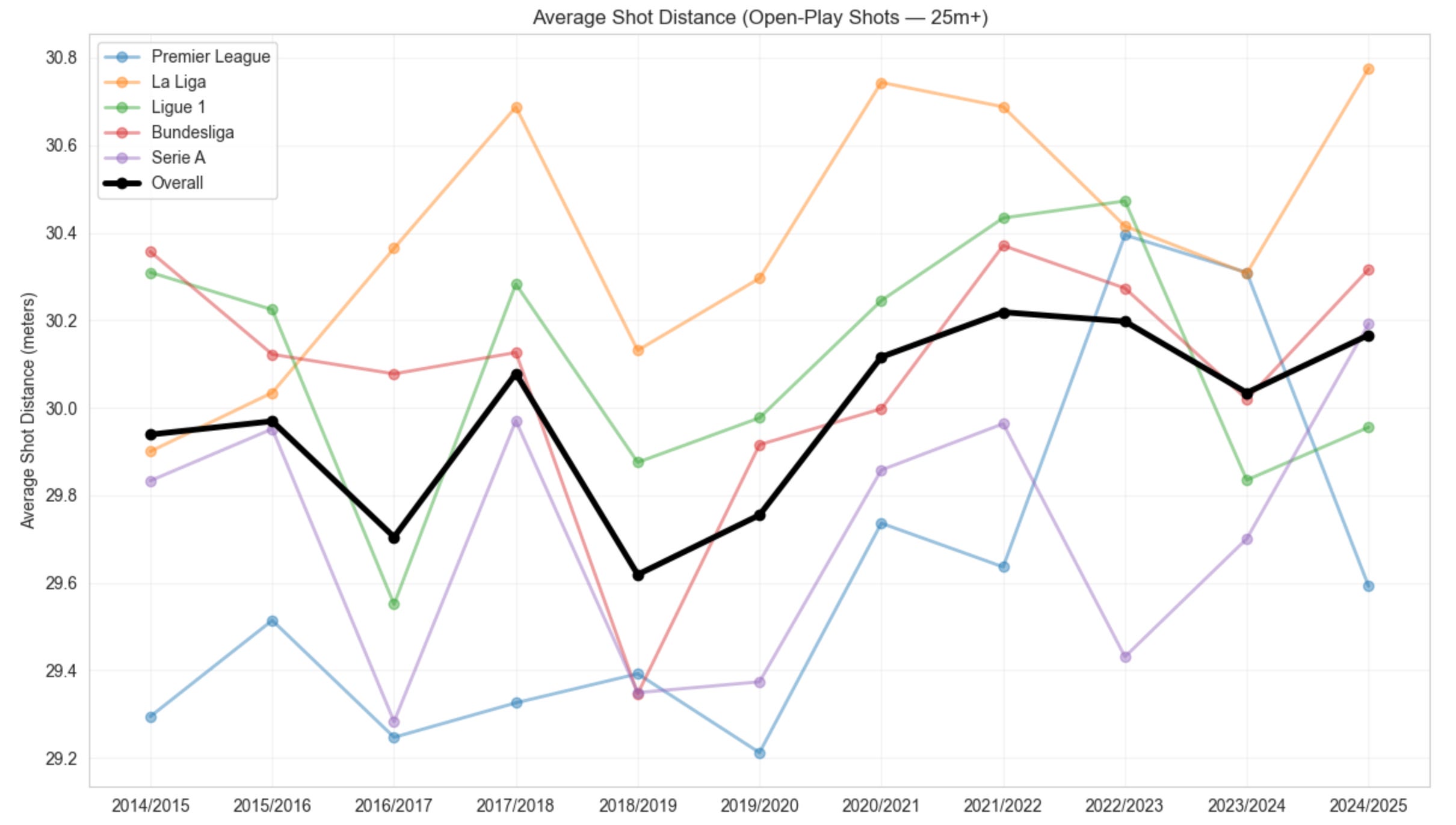
As for true long-range efforts (25m+), the average distance basically stayed the same. Don’t be misled by the upward-sloping line in the chart — yes, it’s increasing, but the Y-axis range is only 1.6 meters. Technically, between 2014/15 and 2024/25, the average distance rose by just 0.8%, from 29.93m to 30.17m. In other words, not significant.
Taken together, this section paints a clear picture:
Teams take the same number of shots as before — but they take far fewer from long range.
Thank you, Captain Obvious. Now that we confirmed what everobody talked about, let’s get into the conversion rates.
3 — Conversion rates
Now comes the fun part: Has this shift actually hurt long-range scoring?
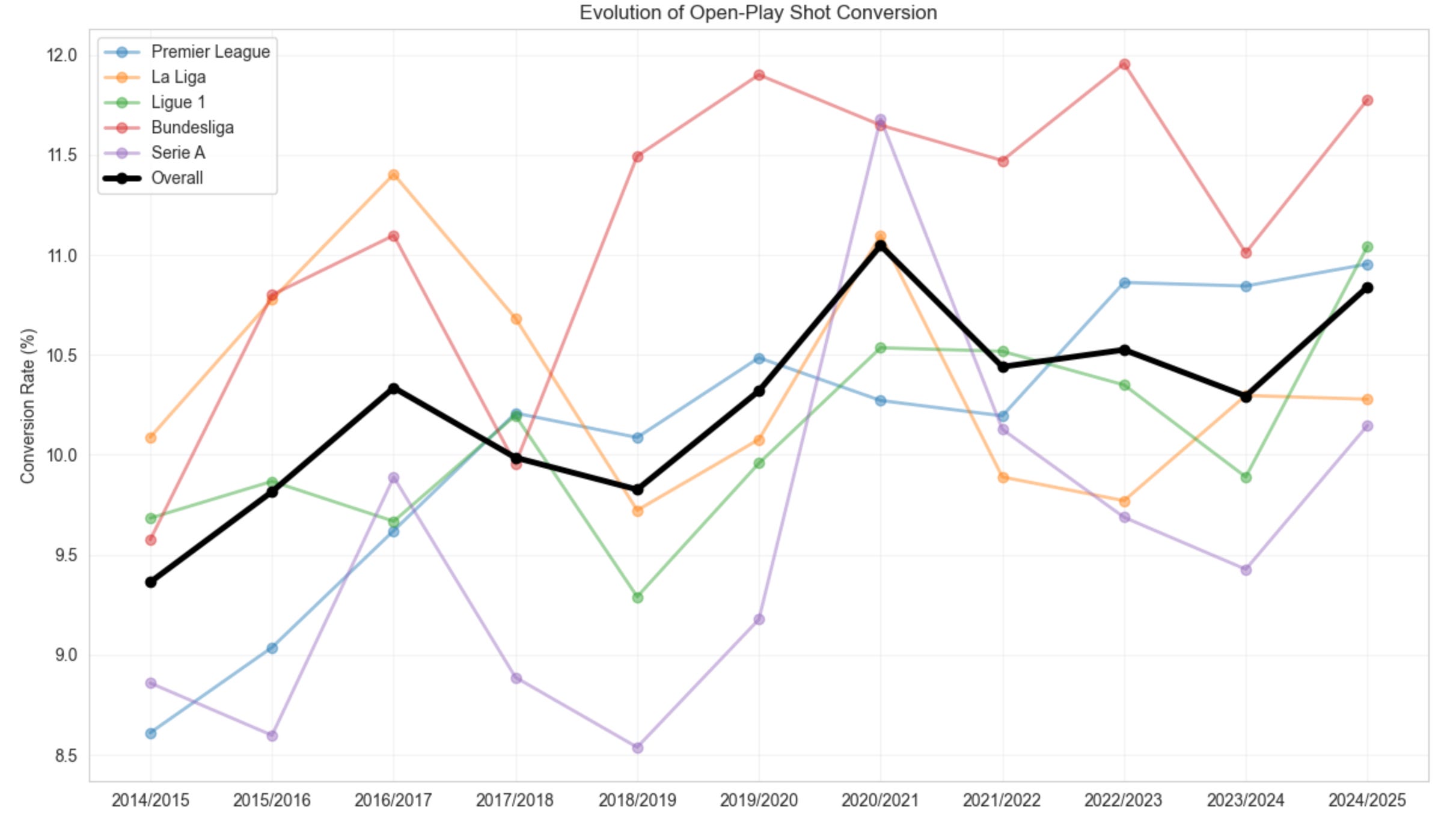
Across all open-play shots, conversion increased from 9.3% to 10.8% — a 1.5 percentage point increase. Should not come as a surprise since shots are being taken from closer positions.
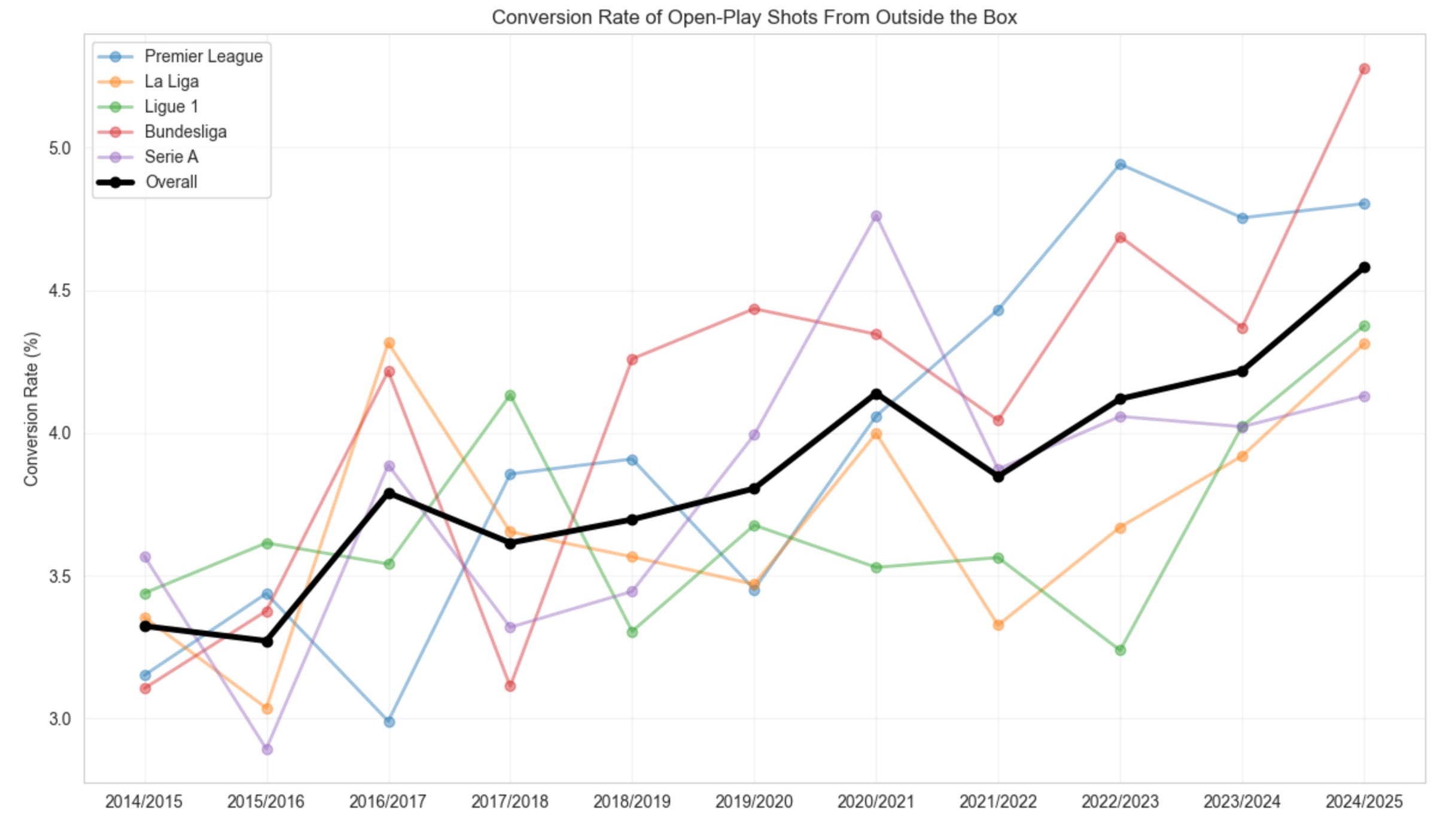
Outside-the-box conversion rose from 3.3% to 4.6% — up 1.3 percentage points, which is meaningful at that low baseline.
As for the long-range shots, conversion increased from 1.7% to 2.8% — a 1.1 pp increase, the largest relative jump of all.
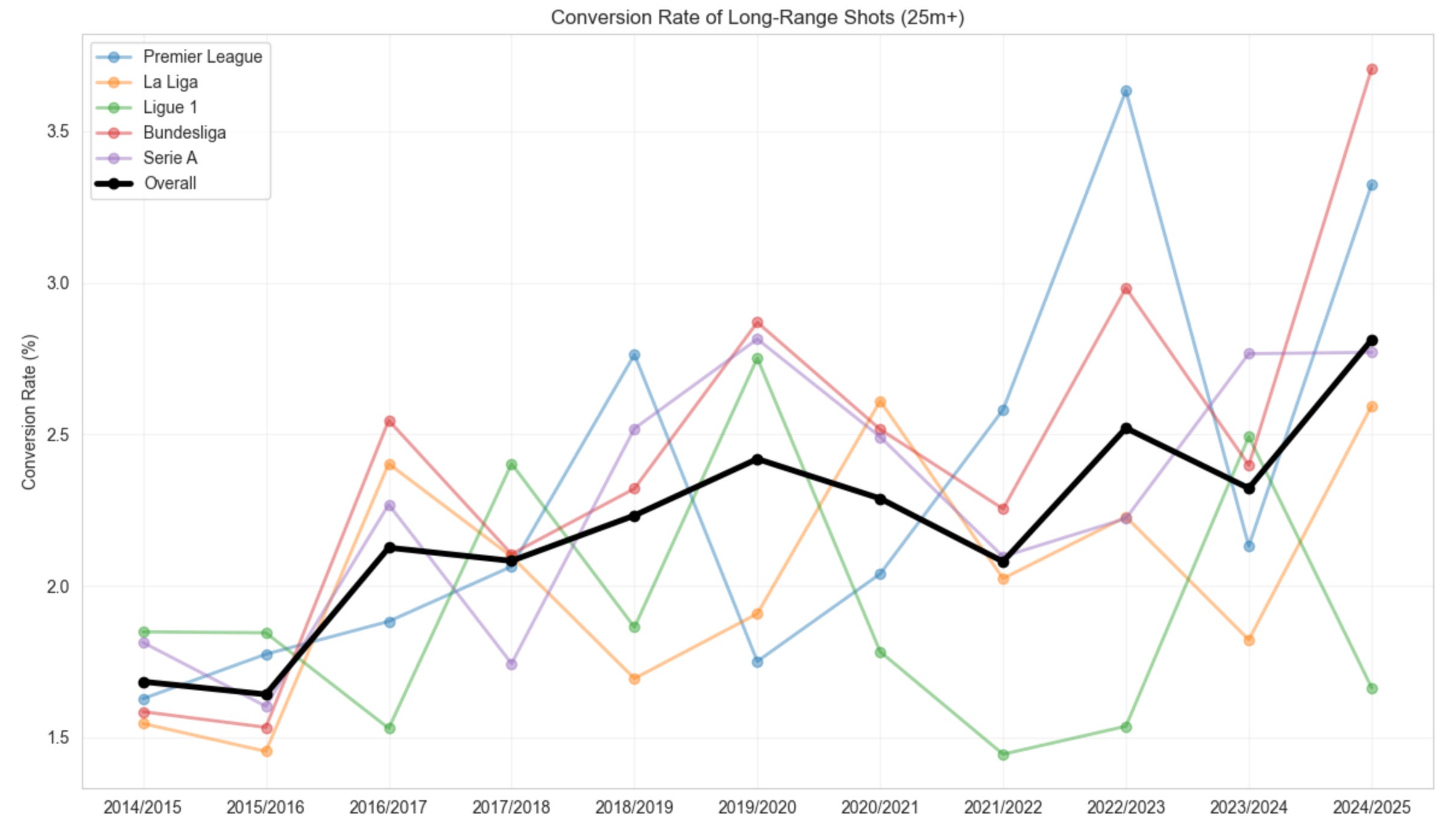
What appears to be happening is teams keeping the risky long shots out of the game.
Long-range shots are clearly on the decline. On average, you’ll only see 1.7 true long-range attempts per match today. But when teams do shoot from distance, the chances of observing a goal as a spectator are 65% higher than a decade ago.
Why? Because only the right players are allowed to try. The long-range “permission” has shifted from everyone to only the players who can actually hit them.
So did xG kill the long-range screamers?
Yes, the average shot distance dropped. Yes, the volume of long-range shots dropped — dramatically. But the idea that screamers are “dead” is… incomplete.
If you care about volume, then yes, long-range shooting is fading.
If you care about expected reward, then screamers are alive and well — in fact, they’re converting at the highest rates we’ve seen in more than a decade.
Modern footballers haven’t stopped shooting from range — they’ve simply stopped shooting bad long-range shots.
So the next time your Granit Xhaka (or your Declan Rice, or your Enzo Fernández) winds up from 25 yards… well, the numbers say it’s a better shot today than it was back in 2014.
And before I leave you, here’s the scatter plot of every player who attempted at least 30 shots across the dataset. Dotted lines are the medians.
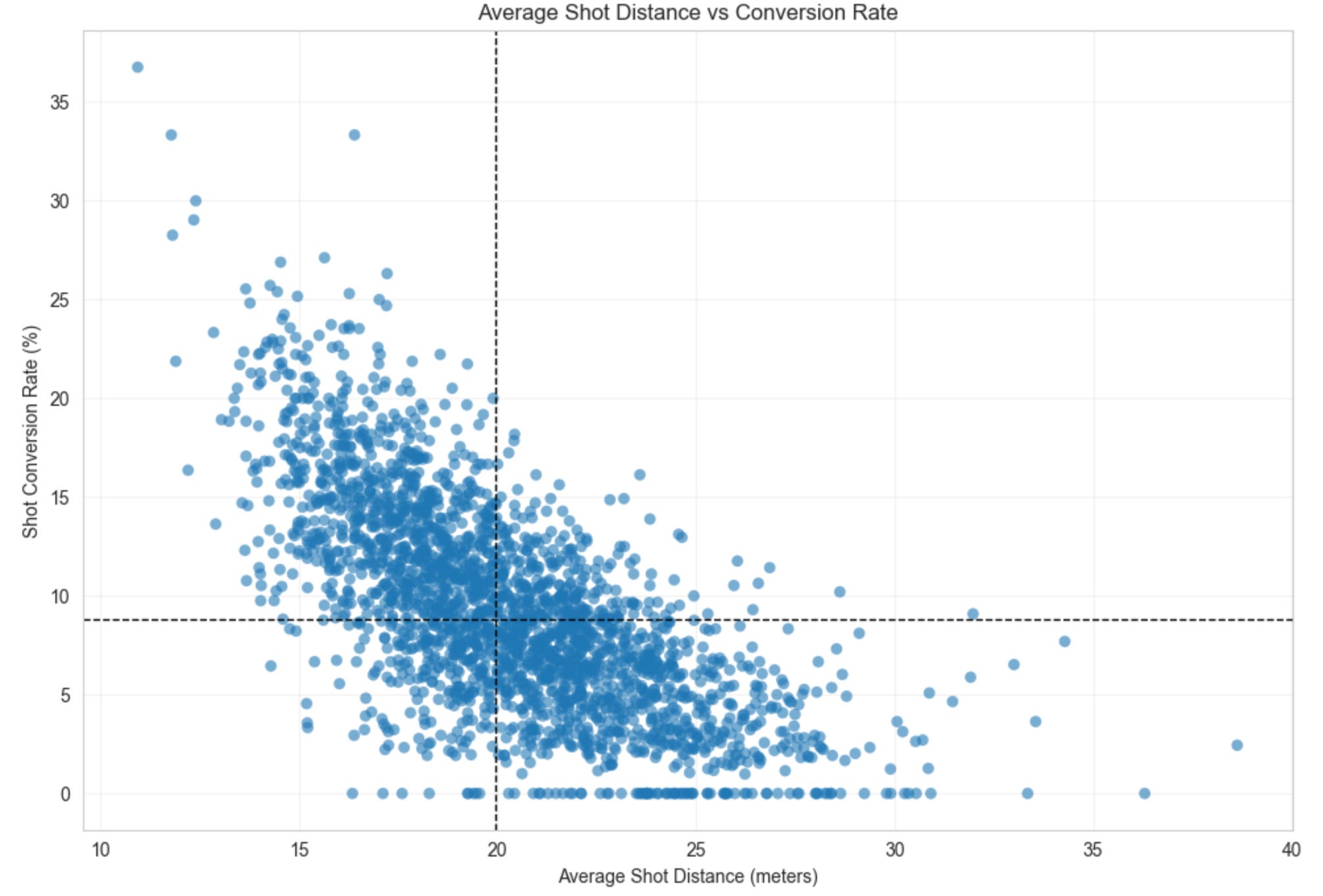
There’s one dot sitting right above the 9% conversion from 31 meters. That’s Xabi Alonso — as if you needed reminding of how outrageous he was from range.
Boom — and that’s the story behind the supposed death of the long-range screamer.
If you’re interested in replicating all the figures from scratch, you can download the full code below.
As always, thank you for reading all the way to the end.
See you next week,
Martin
Really nice, Martin, well done.
My favourite takeaway is the relationship between increase in open play conversion rate overall and the decline in long range shot volume. Really interesting read!